1799 Raised as Light Horses Regiment on 2nd december. 1800 Converted to Horse Grenadiers Regiment of the Consular Guard. 1804 Further to imperial decree of 18 May, the regiment of Horse Grenadiers of the consular Guard is incorporated in the Imperial Guard and organised in 4 squadrons of 2 companies each, established as 1018 troops. 1805 Strength is augmented by two velites squadrons. 1811 Both velites quadrons are disbanded and strength incorporated in others squadrons. Regimental strength is augmented to five squadrons. 1812 Following Russian gampaign, strength decreases to four squadrons. 1813 The regiment is augmented by 2 squadrons which belong to Young Guard. These 2 squadrons are disbanded on 23 July. 1814 With the First Restoration, renamed Corps Royal des Cuirassiers de France. 1815 Resumed Imperial title, and took part at the Hundred Days campaign.
Troopers Dark blue habit with white squared lapels, dark blue collar, scarlet cuffs with white cuffs flaps, scarlet turnbacks ornamented with light orange grenade devices on white patches. Vertical skirt pockets simulated by a scarlet piping. Light orange epaulettes without fringes. Copper buttons. White waistcoat , buff breeches, black heavy cavalry boots. Black bearskin headgear without plate, light orange cord and flounders. Scarlet plume inserted in a tricolour cockade. Copper chinstrap. Scarlet crown with white cross. White leather-work. Black leather cartridge pouch bearing a copper grenade replaced in 1806 by a copper lozenge plate stamped with a crowned eagle. Swordbelt with copper buckle stamped with a grenade. Sabre of Guard Heavy Cavalry pattern, white swordknot, black leather scabbard covered by a copper sheet. Cavalry musket with brass fittings and bayonet. Schabraque, portmanteau and holster dark blue edged with light orange band and piping, shabraque embroidered with light orange imperial crown in the rear corners. Black leather French harness. Black horses.
NCO’s Troopers dress with rank stripes.
Officers Troopers’ dress with gold rank epaulettes. All light orange ornament become gold.
Trumpeters Sky blue habit with crimson squared lapels with gold edging and buttonholes lace, sky blue collar with gold edging. Crimson turnbacks ornamented with light orange grenade devices. Red epaulettes with gold crescent and edging. Aiguillette of mixed red and gold thread. White bearskin headgear. Cord and flounders of mixed red and gold thread . White plume with sky blue top. Shabraque and holster crimson edged with gold band and piping. Sky blue portemanteau edged with gold band and crimson piping. Black leather French harness. Grey horses.
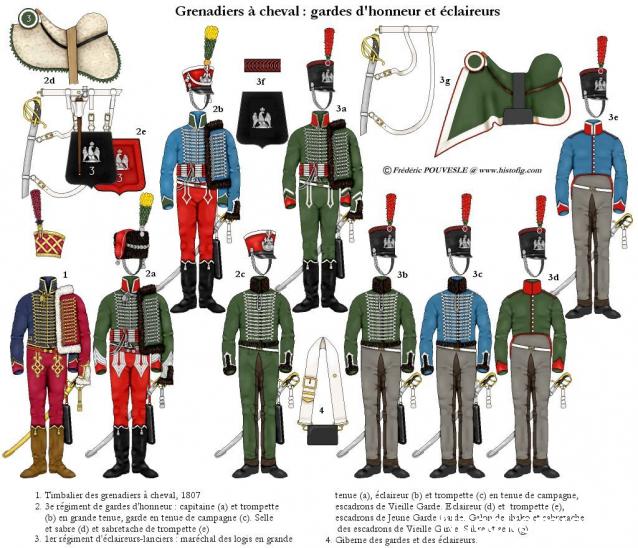
1813 Further to imperial decree of 9 December, the 1st regiment of Scout Lancers of the Guard is created and organised in 4 squadrons of 250 men of which two (which men come from Guards of Honour regiments) belong to Old Guard and two (which men come from line) belong to Young Guard. 1814 The regiment is disbanded and his men reintegrated in line.
Old Guard squadrons Uniform of hussar pattern, green dolman with white laces and braid. Scarlet collar with white edging. Scarlet pointed cuffs with white edging. Scarlet sash with white sliding loops and cord. Green pelisse with white edging , white lace and black fur. Grey breeches with crimson lace. Black shako with white metal eagle. Black top band embroidered with red loops. Red plume with black base over tricolour cockade. White metal chinstrap. White leather-work. Light cavalry sabre with copper hilt and iron sheath, white swordknot. Black wood lance and pistols for the lancers ranks, carbine and bayonet for the carabiniers ranks. Shabraque and portemanteau of green cloth edged with white band and scarlet piping. Black leather light cavalry harness.
Young Guard squadrons Green chasseur pattern habit ("a la Kinski"). Scarlet collar. Scarlet pointed cuffs. Grey overalls with red side band. Black shako with silver eagle. Black top band embroidered with red loops. Red plume inserted in a tricolour cockade. Silver chinstrap.
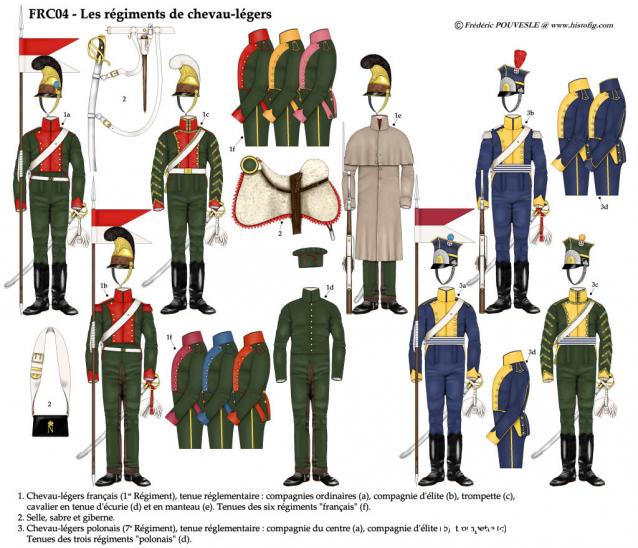
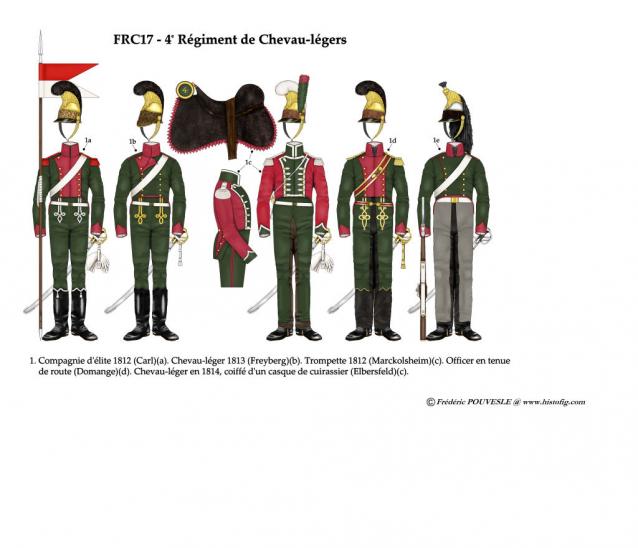
Light horses of the first six regiments Short tailed coat of dark green cloth. Regimental colour collar with green piping. Green shoulder straps piped in regimental colour. Regimental colour squared lapels hooked down to the waist. Regimental colour pointed cuffs. Turnbacks in regimental colour bearing a green cloth eagle badge and Soubise pockets simulated by a piping in regimental colour. Brass buttons. White cloth sleeveless vest and dark green cloth stable vest. Dark green Hungarian breeches with bright yellow side band and black leather Hungarian boots. In field dress, dark green cloth overalls with regimental colour piping and black leather inserts. Sleeved riding mantle with half-cape and facing coloured trim. Helmet with brass crown and brass crest bearing a black fur caterpillar. Around crown, turban in false panther fur. Black leather peak and neck guard with brass strengthenings. Brass chinscales. From 1813, company coloured pompon. White leatherwork. Black leather cartridge pouch bearing a brass crowned N. Light cavalry sabre with brass three bars hilt and steel sheath. Black wood lance with scarlet over white pennon. Black leather light cavalry harness. Hungarian saddle with white sheepskin saddle cover trimmed with facing coloured wolf teeth. Dark green cloth cylindrical portmanteau laced yellow.
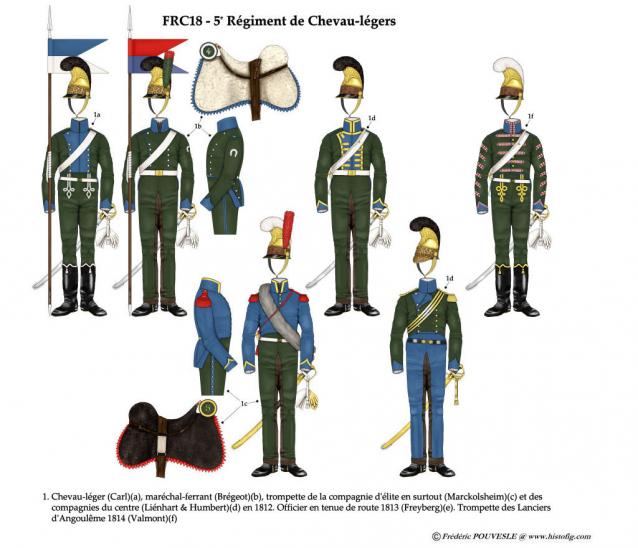
Light horses of the last three regiments Short tailed polish coat of dark blue cloth. Regimental collar. Blue shoulder straps piped in regimental colour. Regimental colour squared lapels hooked down to the waist. Regimental pointed cuffs. Turnbacks in regimental colour and vertical pockets simulated by a piping in regimental colour. Sleeves and back seams underlined with regimental colour piping. White metal buttons. White cloth sleeveless vest and dark blue cloth stable vest. Dark blue polish trousers with bright yellow side band and black leather light boots. In field dress, dark blue cloth overalls with regimental colour piping and black leather inserts. Overcoat as French regiments. Czapska with dark blue cloth top piped and laced in regimental colour and black leather crown bearing a white metal sunrays plate with brass centre stamped with crowned N cipher. Company coloured pompon over tricoloured cockade with white Maltese cross. Black leather peak and white metal chinchain. Same equipment as French regiments. Cloth sash with white and blue stripes worn over sabre belt. Lance with crimson over white pennon. Same horse equipment as French regiments. Dark blue cloth cylindrical portmanteau laced in regimental colour. Elite companies Fringed epaulets in red thread in French regiments and white thread in Polish regiments. From 1813, red plumes tuft.
NCOs Yellow (white in Polish regiments) or gold (silver in Polish regiments) rank chevrons over both cuffs.
Officers Troopers’ dress with gold (silver in Polish regiments) thread rank epaulets. Saddle covers in green (blue in Polish regiments) cloth laced gold (silver in Polish regiments) embroidered with a gold (silver in Polish regiments) crowned N in front corner and a crowned eagle on crossed lances in rear corner. Officers often wear a Minerva style helmet with fur extending on peak and neck guard.
Trumpeters and musicians Dress of trumpeters and musicians, when known, is detailed in regimental plates. Trumpeters usually wear troopers’ helmet with white fur caterpillar. In 1811 and 1812 they usually wear the trooper’s dress in reversed colours with collar, lapels, cuffs and waist buttons laced white. From 1813, short tailed habit-veste in green cloth closed by a row of nine buttons. Regimental collar with imperial livery lace trim. Facing colour piping on front of coat, bearing five livery buttonhole laces. Livery laces trim to cuffs and turnbacks. Livery lace trim to pockets. Green and yellow trumpet’s cord.
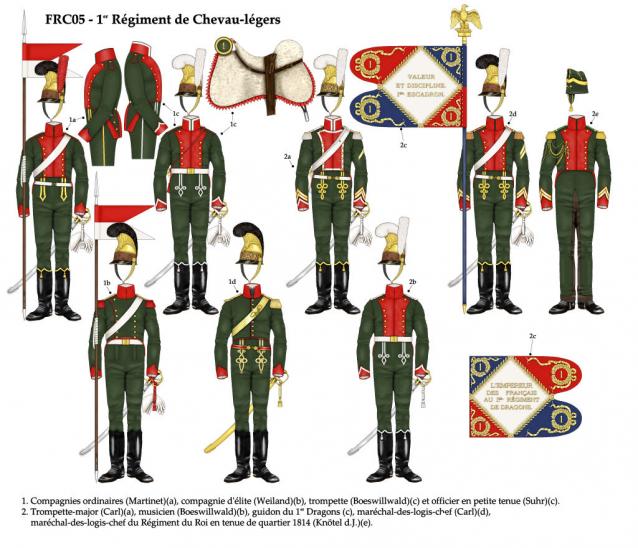
Decree of June 18, 1811 converts the 1st Dragoons Regiment into 1st Light Horses Lancers Regiment. Assigned to the Observation Corps of the Elbe, he takes part in campaign of 1812 in Russia, 1813 in Germany and 1814 in France. The regiment takes, on May 12, 1814, the title of King’s Regiment of Lancers, and it is reinforced with the remnants of the 9th Lancers Regiment. During the Hundred Days campaign, it is assigned to Colbert cavalry brigade and fights gallantly at Waterloo. Disbanded in 1815, strength is transferred to the Regiment of Chasseurs à Cheval de la Côte-d’Or (8th Chasseurs).
Unit commanders 5 April 1807(1st Dragoons then 1st Lancers): Paul Dermoncourt 5 August 1813: Jean-Baptiste Jacquinot Battles
1812 : Smolensk, La Moskowa 1813 : Dresde, Leipzig, and Hanau 1814 : Reims and Paris 1815 : Waterloo
Standards When created, the Regiment keeps one of the eagles of its parent 1st Dragoons Regiment. It is granted in 1812 with a standard of 1812 model with the following battles names :
ULM AUSTERLITZ IENA EYLAU FRIEDLAND
Plate caption 1. Centre companies (Martinet)(a), elite company (Weiland)(b), trumpeter (Boeswillwald)(c) and officer in undress (Suhr)(c). 2. Trumpeter-major (Carl)(a), musician (Boeswillwald)(b), 1st Dragoons standart (c), sergeant-major (Carl)(d), sergeant-major of King’s Lancers in quarter dress 1814 (Knötel d.J.)(e).
Decree of June 18, 1811 converts the 3rd Dragoons Regiment into 2nd Light Horses Lancers Regiment. It takes part in campaigns of Russia in 1812, Germany in 1813 and France in 1814.
The regiment, reinforced by companies of the 7th Light Horses Lancers Regiment, is renames as Queen’s Lancers Regiment on 12 mai 1814. During the Hundred Days campaign it belongs to Colbert’s brigade and distinguishes itself at Waterloo.
2nd lancers is disbanded in 1815 and strength transferred in Marne Chasseur-a-Cheval Regiment (12th Chasseur-a-Cheval).
Unit commanders 2 August 1809: Pierre Berruyer 23 February 1814 : Jean Joannès 9 October 1814 : Jean-Baptiste Sourd
Battles 1812 : Borodino and Beresina 1813 : Katzbach and Hanau 1814 : La Rothiere, Montmirail, Vauchamps, Bar-sur-Aube and Fère-Champenoise 1815: Waterloo
Standards When created, the Regiment keeps one of the eagles of its parent 3rd Dragoons Regiment. It is granted in 1812 with a standard of 1812 model with the following battles names :
ULM AUSTERLITZ IENA EYLAU FRIEDLAND
Plate caption 1. Light horse 1812 (Bellangé)(a) and 1814 (Elbersfeld)(b). Trumpeter (c) and corporal (d) of the elite company (Carl). 2. Elite company officer (a), sergeant (b), trumpeter -major (c), and musician (d) in 1812 (Bœrsch). 3. Standard 1812-1814.
Decree of June 18, 1811 converts the 8th Dragoons Regiment into 3rd Light Horses Lancers Regiment.
It takes part in campaigns of Russia in 1812 in the Observation Corps of the Elbe in the Grand Army, of Germany in 1813 and France in 1814 in the 1st Cavalry Corps.
Brought up to full strength on 1st September 1814, it is renamed as Heir Prince’s Lancers and fights at Waterloo in the 1st Army Corps. It is disbanded on 14 February 1816 and strength transferred in the new Allier Chasseurs (1st Chasseurs-a-Cheval).
Unit commanders 22 June 1811: Alexandre Lebrun 11 March 1813: Charles Hatry 20 April 1814 - 9 October 1814: Eugene Texier d’Hautefeuille 9 October 1814 - 19 April 1815 : Francois Michel 19 April 1815 : Charles Martique
Battles 1812 : Polotsk and Berezina 1813 : BautBautzen, Dresden, Leipzig and Hanau 1814 : Champaubert and Vauchamps 1815: Ligny and Waterloo
Standards When created, the Regiment keeps one of the eagles of its parent 8th Dragoons Regiment. It is granted in 1812 with a standard of 1812 model with the following battles names :
ULM AUSTERLITZ IENA EYLAU that is taken on November 28, 1812 during Berezina battle.
Plate caption 1. Light horse 1812 (Martinet)(a). Centre companies’ trumpeter in march order (Marckolsheim)(b) and of elite company in full dress (reconstitution)(c). Quartermaster in society dress (Vernet)(d).
Decree of June 18, 1811 converts the 9th Dragoons Regiment into 4th Light Horses Lancers Regiment.
It joins the Cavalry Reserve of the Grand Army and takes part in the campaign of Russia in 1812 in the 4th Cavalry Corps, and of Germany in 1813 and France in 1814 in the 2nd Cavalry Corps.
After the first Restoration, the regiment, reinforced by 3rd and 4th (Young Guard) squadrons of the 2nd Guard Lancers, is renamed as Lancers of Monsieur (title of King’s brother) and fights during Waterloo campaign in the 1st Army Corps. It is disbanded in 1816 and strength transferred in the new Vendee Chasseurs (22nd Chasseurs-a-Cheval).
Unit commanders 31 December 1806 : Mathieu Queunot 14 October 1811 : Jean-Louis Deschamps 21 April 1815 : Louis Bro
Battles 1812 : Borodino and Winkowo 1813 : Leipzig and Hanau 1814 : Champaubert and Vauchamps 1815: Fleurus and Waterloo
Standards When created, the Regiment keeps one of the eagles of its parent 9th Dragoons Regiment.
It is granted in 1812 with a standard of 1812 model with the following battles names :
ULM AUSTERLITZ IENA EYLAU Plate caption 1. Elite company 1812 (Carl)(a). Light horse 1813 (Freyberg)(b). Trumpeter 1812 (Marckolsheim)(c). Officer in marching order (Domange)(d). Light horse in 1814, wearing a cuirassier helmet (Elbersfeld)(c).
Decree of June 18, 1811 converts the 10th Dragoons Regiment into 5th Light Horses Lancers Regiment. It joins the Cavalry Reserve of the Grand Army and takes part in campaigns of Russia in 1812 in the 5th Cavalry Corps, of Germany in 1813 and France in 1814.
After the first Restoration, the regiment, reinforced by 5th (Young Guard) squadron of the 2nd Guard Lancers, is renamed as Lancers of Angouleme and fights during Waterloo campaign in the 2nd Army Corps. It is disbanded on 21 November 1815 and strength transferred in the new Vosges Chasseurs (24th Chasseurs-a-Cheval).
Unit commanders 1811 : François Chabert 1815 : Jean-François Jacqueminot de Ham
Standards When created, the Regiment keeps one of the eagles of his parent 10th Dragoons Regiment. It is granted in 1812 with a standard of 1812 model with the following battles names :
ULM AUSTERLITZ IENA EYLAU FRIEDLAND
Plate caption 1. Light horse (Carl)(a), blacksmith (Brégeot)(b), trumpeter of elite company in habit-surtout (Marckolsheim)(c) and of centre companies (Lienhart & Humbert)(d) in 1812. Officer in marching order 1813 (Freyberg)(e). Trumpeter of Angouleme Lancers (Valmont)(f).
Decree of June 18, 1811 converts the 29th Dragoons Regiment into 6th Light Horses Lancers Regiment.
It takes part in campaigns of Russia in 1812, Germany in 1813 and France in 1814.
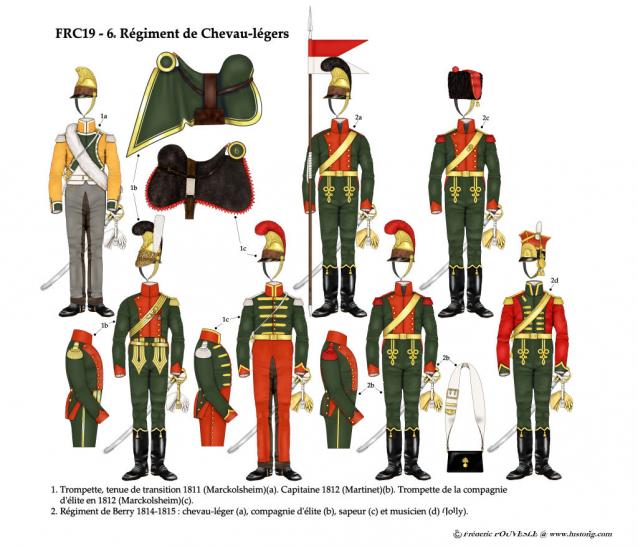
After the first Restoration, the regiment, reinforced by the remnants of the 12th Hussars Regiment is renamed as Lancers of Berry and fights during Waterloo campaign in the 2nd Army Corps. It is disbanded in 1816.
Unit commanders 28 May 1803: Jacques Avice 14 October 1811: Laurent Marbeuf 11 March 1813: Sébastien Perquit 25 February 1813: Nicolas de Galbois
Battles 1812: Krasnoïe, Smolensk, Borodino and Berezina 1813: Leipzig and Hanau 1814: Champaubert, Montmirail, Vauchamps, Arcis-sur-Aube and Saint-Dizier 1815: Fleurus and Waterloo
Standards When created, the Regiment keeps one of the eagles of its parent 29th Dragoons Regiment. It is granted in 1812 with a standard of 1812 model with the following battles names :
WAGRAM
Plate caption 1. Trumpeter in provisional dress 1811 (Marckolsheim)(a). Captain in 1812 (Martinet)(b). Trumpeter of elite company in 1812 (Marckolsheim)(c). 2. Berry Lancers Regiment 1814-1815: light horse (a), elite company (b), sapper (c) and musician (d) (Jolly).
Decree of June 18, 1811 converts the 1st Vistula Lancers Regiment into 7th Light Horses Lancers Regiment. It is posted in Spain until 1812 and joins the Grande Armée in 1813 to take part in campaign in Germany in 1813 and France in 1814. The 7th Light Horses Regiment is disbanded in May 1814.
Unit commanders 15 July 1807: Jan Konopka 22 October 1811: Stanislas Klicki May 1812: Ignace Ferdinand Stokowski 2 July 1813: Casimir-Alexandre Tanski 19 January 1814: Thomas Lubienski
Battles 1813 : Dresden and Hanau 1814 : Montereau Standards No known standard.
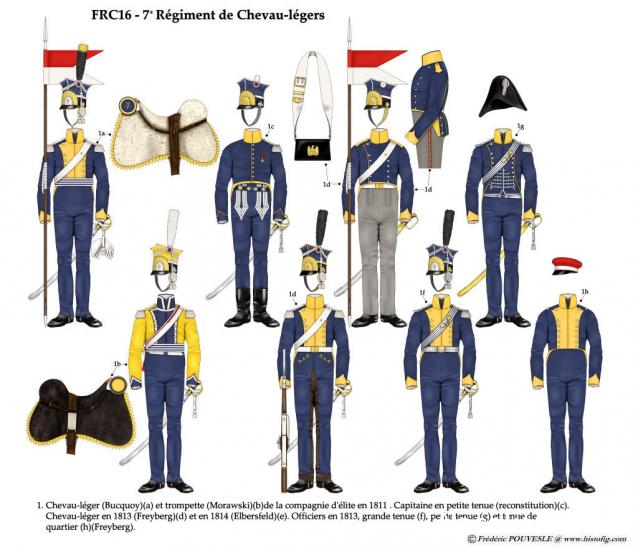
Plate caption 1. Light horse (Bucquoy)(a) and trumpeter (Morawski)(b) of the elite company in 1811. Captain in everyday dress (reconstitution)(c). Light horse in 1813 (Freyberg)(d) and in 1814 (Elbersfeld)(e). Officers in 1813, full dress (f), everyday dress (g) and quarter dress (h)(Freyberg).
Decree of June 18, 1811 converts the 2nd Vistula Lancers Regiment into 8th Light Horses Lancers Regiment. It takes part in campaigns of Russia in 1812 in Corbineau brigade of 2nd Army Corps, Germany in 1813 and France in 1814. The 8th Light Horses Regiment is disbanded on January 19 1814 and remaining strength transferred to 7th Regiment.
Unit commanders 8 February 1811: Thomas Lubienski Battles
1812 : Polotsk and Beresina 1813 : Lutzen, Bautzen, Dresden and Leipzig 1814 : Champaubert
Standards No known standard.
Plate caption 1. Light horse 1811 (Knötel)(a) and 1812 (Bregeot)(b). Trumpeter in full dress (Knötel d.J.)(c) and in parade dress (Marckolsheim)(d) in 1812.
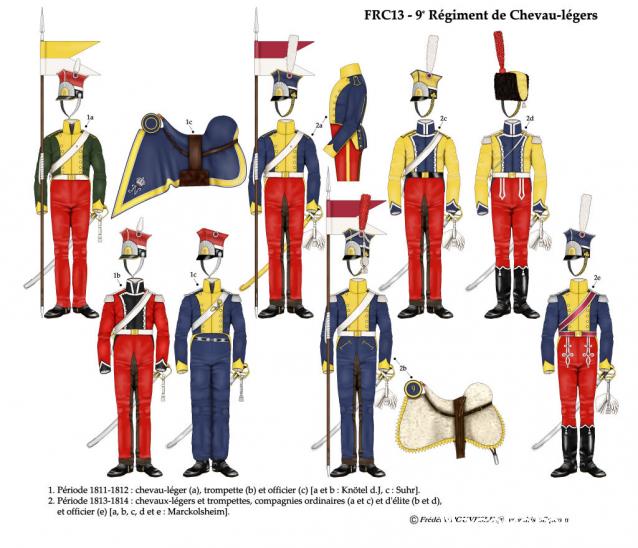
Decree of June 18, 1811 converts the 30th Chasseurs Regiment into 9th Light Horses Lancers Regiment. It takes part in campaigns of Russia in 1812, Germany in 1813 and France in 1814. The 9th Light Horses Regiment is disbanded in May 1814.
Unit commanders 14 March 1811: Martin Gobrecht 13 July 1813: Jan Fredro 26 September 1813: Gaspard Hug
Battles 1812 : Vitebsk, Ostrowno, Borodino and Berezina 1813 : Mockern and Kulm 1814 : Vauchamps
Standards Unknown standard.
Plate caption 1. 1811-1812 period: light horse (a), trumpeter (b) and officer (c) [a and b : Knötel d.J, c : Suhr]. 2. 1813-1814 period: light horse and trumpeter of centre companies (a and c) and elite company (b and d) and officer (e) [a, b, c, d and e : Marckolsheim].
Вы не можете начинать темы Вы не можете отвечать на сообщения Вы не можете редактировать свои сообщения Вы не можете удалять свои сообщения Вы не можете добавлять Фото





 дальше 8, 9